Screw Fastening Process
Axial rotary movement connects components to each other by positive locking

In the screw fastening process, components with axial rotational movement are connected by positive locking. By applying the appropriate torque when tightening the screw, a preload is introduced into the connection, which creates a self-locking effect against loosening due to frictional locking in the thread flanks.
Anti-loosening devices such as adhesives or lacquers can also be used to prevent the preload force from decreasing. Screw fastening is a flexible and reliable joining technique with many applications in modern manufacturing. It allows for temporary and permanent joints, making it suitable for a wide range of applications.
When paired with automation, screw fastening delivers high efficiency, consistency, and reliability of assembly processes while lowering long-term costs.
Screw Driving Process

The screw is placed in a pilot hole in the component. In the case of a self-tapping screw, it is placed against the part. Then, a screwdriver applies axial rotation to engage the screw's threads with the component.
The applied torque creates an axial clamping force, also known as preload, that pulls the connected parts together. This compresses the interface, creating a form-fitting joint.
In industrial settings, screw driving is often automated to increase efficiency and ensure consistency. This is accomplished by using specialized screw driving solutions that precisely control torque, rotation angle, and displacement.
Automatic Screwdriver System for Robots
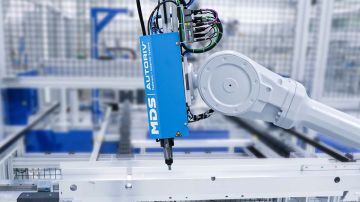
Design as EOAT tool or workstation for robots

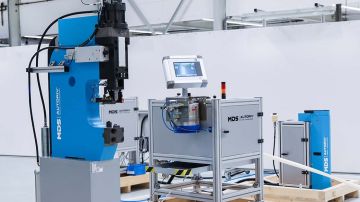
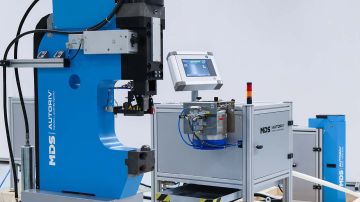
The flexible screw driving system provides fully automated and reliable screw fastening. Its monitored tightening process eliminates errors and ensures consistent joint quality. The screw driving system can be mounted on a welded steel frame and used as a stationary robotic workstation A240-SAS. It can also be attached directly to a robot’s arm as an end-of-arm tool A230-SAS.
The screwdriver can install various types of fasteners, including standard screws, threaded inserts, thread-forming screws, and flow-forming screws. This tool can apply up to 40 Nm of torque for most screw and threaded insert applications. There is also a version of the tool that uses thread-forming screws and delivers up to 80 Nm of torque.
Automated Process Flow
The robot picks up the component and moves it to the automatic screwdriver. Then, the higher-level control system signals the screwdriver to start. The setting process only begins once the screw fastener is in the correct position. The integrated displacement measurement system signals the start of the screw driving process once the screw is in position.
If any deviations from the target specifications are detected—such as with the thickness of the component sheet or the height of the fastener—the setting process is interrupted, and an error message is sent to the higher-level control system. This virtually eliminates the possibility of incorrect settings. The setting process is torque-controlled. Once the specified torque is reached, a message indicating successful completion of the process is issued.
Advantages of the Screwdriving System
The assembly unit achieves high productivity thanks to its parallel loading and fastening processes. While one screw is being set, the next fastener is being fed and prepared. This means that the screw loading time does not add to the cycle time, resulting in faster throughput. Optimized synchronization of feeding and tightening operations ensures high process efficiency and minimizes idle time in the assembly sequence.
All critical components are made of wear-resistant materials and are designed to withstand heavy loads in industrial environments. This robust construction minimizes wear and tear, reducing maintenance frequency and ensuring reliable, long-term performance under continuous production conditions.
All relevant components are easily accessible, and the robust construction of the system ensures a high level of operational reliability. Its clear layout and modular design facilitate quick troubleshooting and ensure long-term system availability.
Both the screw driving unit and the feeding system are compact and space-efficient. This allows for easy integration into existing production lines or confined assembly cells. The compact design also contributes to shorter cable paths and optimized ergonomics. This simplifies installation and maintenance while preserving valuable floor space.
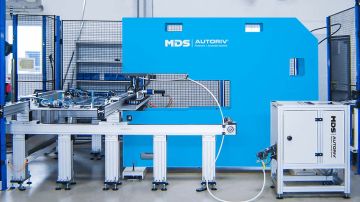
The feeding unit of the system is positioned outside the robot safety cell, which provides operators and maintenance technicians with easy access. This setup enables quick refilling of fasteners, visual inspections, and service interventions without interrupting production or entering the robot’s protected zone. As a result, downtime for maintenance and loading is minimized.
The system provides advanced monitoring and evaluation capabilities for each assembly operation. All relevant process data is recorded, evaluated, and stored for documentation and traceability purposes. These features guarantee consistent quality and ensure full process safety. Any deviations or irregularities are immediately detected, allowing for corrective actions before defective parts leave the production line.

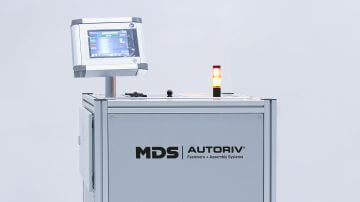
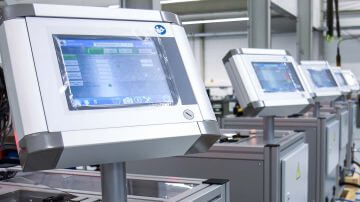
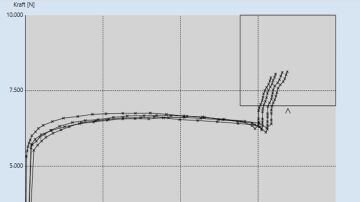
A graphical interface uses either a torque-rotation angle or a torque-path evaluation to visualize the tightening process. This real-time visualization allows for precise analysis of each screw connection, ensuring that every joint meets the specified quality assurance and documentation requirements.
The control software enables the system to swiftly adapt to various specifications. This makes the assembly system ideal for flexible production environments, where changes to the assembly process may be necessary. Different application cases can be accommodated by editing program parameters.
Application Examples

Fully automated screw driving systems are crucial for assembling automotive chassis, suspensions, and structural body components. Within the chassis, robotic screwdrivers fasten axle carriers, cross members, and engine or transmission mounts with precise torque control.
Automated screw driving in suspension and steering systems ensures the control arms, wishbones, strut assemblies, and steering brackets are accurately tightened. These joints must be able to withstand continuous dynamic loads and maintain alignment throughout the vehicle’s life cycle.
In body-in-white and structural modules, screw fastening is used alongside welding and riveting to flexibly join dissimilar materials, such as aluminum, high-strength steel, and composites. Typical applications include crash-relevant reinforcements, seat frames, and battery housings in electric vehicles.
Request for Quotation
Would you like us to call you back? Leave your telephone number or e-mail, and we will get back to you as soon as possible!