The Process of Blind Riveting
The material layers are joined together on one side with blind rivets

Blind riveting is the process of installing blind rivet fasteners to join materials one-sidedly. This means that only one side of the component needs to be accessible for fastening. The other side, or the "blind" side, is either enclosed, obstructed, or physically unreachable.
Blind riveting is a flexible and reliable technique with many applications in modern manufacturing. It can be used in many industries, including automotive, HVAC and appliances. It works well with various materials, including metal, plastic, composites, and mixed combinations. Blind riveting is ideal for both manual use and fully automated systems on high-speed production lines.
What Is a Blind Rivet?

Blind rivets, also known as pop rivets or breakstem rivets, are tubular, two-piece fasteners. A standard blind rivet is made up of a hollow metal body with a pre-installed pulling mandrel.
Blind rivets are easy to use and provide a consistent clamping force. There’s no need for threading, welding, or access to both sides of the assembly. They are designed to deform in a controlled manner, so that each joint receives nearly the same amount of pressure and strength once the mandrel breaks. Unlike screws, which can be overtightened or loosened, breakstem rivets provide uniform, reliable fastening in all installations.

From an automation perspective, pop rivets are highly reliable. Their standardized geometry allows for easy handling by automatic assembly tools and feeding systems. Their consistent performance under load makes them ideal for automated installation processes and process monitoring.
Blind rivets are made from various materials, including aluminum, steel, brass, and copper. They also come in different head styles and special designs, including gas- and waterproof options, to suit a variety of applications.
The Assembly of Blind Rivets

First, the tool grips the blind rivet by its mandrel and places it in a pre-drilled pilot hole on the accessible side of the component.
The tool then applies a pulling force to the blind rivet, pulling the mandrel back. As this occurs, the rivet body deforms and expands on the back of the component, firmly clamping all the material layers together.
A form-fitting joint is created between the pop rivet and the component. After applying the appropriate force, the mandrel snaps off and is removed, leaving the rivet in place.
Assembly System for Blind Rivets
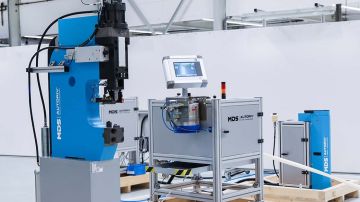
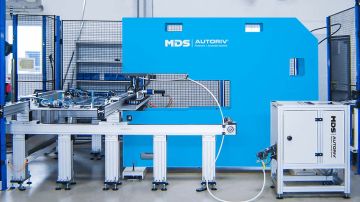
Design as EOAT tool or workstation for robots

Functionality
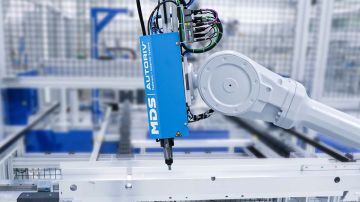
The A230-BI-R robotic end-of-arm tool is used for setting breakstem rivets and is designed for attachment to a robot.
The basic functions of the riveting unit are automatic loading, feeding the rivets into the component, and process monitoring during the setting process.
The assembly unit sets round blind rivets, which are pulled over a break-off mandrel. A feeding system supplies the rivets. During the setting process, a gripper on the setting unit requests rivets and transfers them as needed.
Loading and Feeding Blind Rivets
The empty assembly unit requests a blind rivet from the gripper (1). The gripper extends, and the setting unit moves toward the rivet. Suction air (vacuum) is activated to pick up the pop rivet. The rivet is preloaded via the gripper jaws so that it is not lost. After loading, the setting unit inserts the blind rivet into the component.

Pulling the Rivets
As soon as the setting unit is in the working position, the system reports, "Ready to set." The setting process begins when the higher-level system sends a start signal. The setting cylinder (2) presses the rivet into the component. Sensors monitor the pull path and force (optional) during rivet setting. Once the riveting process begins, a force-displacement curve is recorded for evaluation.
Breaking off and Vacuuming the Mandrel
When the mandrel breaks off, there is a brief reduction in force. The force-displacement curve shows a negative slope at this point. The riveting process terminates when this difference in force is detected. The setting cylinder vacuums up the broken mandrel of the rivet and transports it to a collection container, with the other broken mandrels. A sensor detects when the mandrel has been vacuumed up (3).
Case Study
Automated Blind Riveting in Trunk Lid Reinforcement Manufacturing

In this project, blind riveting played a central role in creating a secure and reliable assembly for a lightweight magnesium die-cast trunk lid reinforcement. The joining process was carried out in a fully automated robotic cell, combining several fastening methods to achieve both strength and efficiency.
The automated sequence involved automatically feeding and blind riveting sheet metal components with breakstem rivets. The process also included installing blind rivet nuts of various sizes, blind rivet studs and ground nuts.
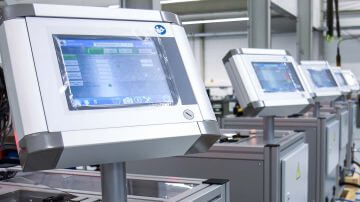
All components were automatically fed into the assembly cell, with riveting and bolting processes executed by robotic systems. The blind riveting stations were fully monitored, ensuring each joint achieved the required installation quality. Process data was logged for documentation and traceability, guaranteeing consistency across every cycle. Apart from the robot itself, all automation units — including rivet feeding, setting, and quality monitoring — were developed and built in-house.
This integration of blind riveting into a complete automation cell highlights how reliable, automatic fastening can be scaled for high-volume automotive production while maintaining lightweight design goals.
Further Application Examples

Automotive
Blind rivets are widely used in the automotive industry, especially in hard-to-reach areas and situations that require speed. This makes them an ideal fastening solution for many applications. They are essential for body-in-white assembly and for joining panels, reinforcements, and stiffeners in areas where other techniques, such as spot welding, are impossible. Blind rivets fasten interior components such as seat structures, dashboards, and door modules. They are also essential for assembling electric vehicle battery packs. Pop rivets secure covers and thermal shields as well.

HVAC
The HVAC industry relies on blind rivets for lightweight sheet metal construction. They are a common fastening method for long runs of galvanized steel ducting. Breakstem rivets are also widely used in air purifiers and HVAC accessories, especially for plastic-to-metal joints. Outdoor units, such as rooftop HVAC enclosures, rely on rivets to secure panels that can withstand vibrations and weather exposure. Additionally, technicians often use pop rivets for retrofitting and servicing, as they enable access from one side in tight ceiling spaces.

White Goods
Blind riveting is a popular method for fastening components in the manufacturing of white goods because it is quick, durable, and resistant to vibration. For example, rivets in washing machines and dryers secure drum housings, frames, and panels that must withstand repeated cycles and vibrations. Refrigerators and freezers use rivets to attach sheet metal panels, hinges, and brackets more efficiently than screws. Ovens and dishwashers benefit from rivets that can withstand heat, steam, and repeated door movement, ensuring long-term reliability. Even smaller appliances, such as microwaves and coffee makers, use rivets to quickly assemble their housings.
Advantages of Blind Rivets
The key advantage of blind rivets is that they can be installed when the back side of the joint is inaccessible. This makes them ideal for enclosed structures, ducts, and vehicle bodies.
There is no need for tapping, threading, or welding. The riveting process is straightforward, and each pop rivet can be set in seconds.
Breakstem rivets provide consistent clamping force to ensure reliable joint integrity. Unlike screws, they won't loosen over time due to vibration.
They can bond dissimilar materials, such as metal to plastic, metal to composite, or aluminum to steel, without the need for special preparation.
Blind rivets are a durable fastening solution that doesn't add significant weight. This makes them ideal for lightweight applications.
Pop rivets create joints that are tamper-resistant and do not require re-tightening or maintenance after installation.
Breakstem rivets are ideal for rivet automation and high-speed production lines due to their standardized shape and predictable setting behavior.
Breakstem rivets are inexpensive, and automation reduces labor costs while increasing production output. These factors provide a strong ROI in high-volume production.
Request for Quotation
Would you like us to call you back? Leave your telephone number or e-mail, and we will get back to you as soon as possible!