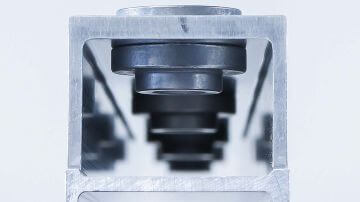
Press-Fit Combination of Rivet Nut and Washer/Spacer
For a wide range of functions and applications
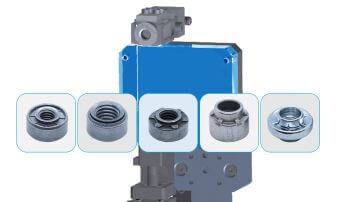
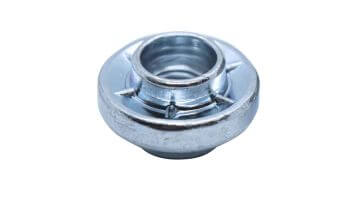
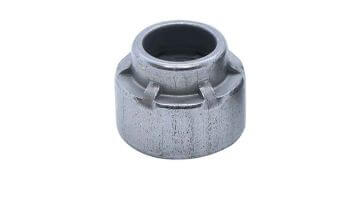
A press-fit combination of a rivet nut and washer creates a high-strength structural connection. This connection is ideal for components with limited installation space. The combination can also be used as a spacer or to reinforce thin sheets.
The principle of the nut and washer combination is also used in the so-called spin-pull process for components with joints that can only be accessed from one side, such as closed profiles.
Contact Us
Our customer service will help you with any questions!
Applications

The nut-washer combination is particularly suitable
- For tightly toleranced distances between bolted components
- As a frame rail/crash box combination
- As connecting thread for large sheet thicknesses where no beading is possible
- For large sheet thicknesses where no protrusion is possible
- As form closure or anti-twist lock for attachments
- as a chemical insulator between steel and aluminum
- As form closure to counteract displacement forces
- For battery-carrier connection
- As stop surface
- As spacer for tightly toleranced distances
- As sheet reinforcement for thin sheets

Assembly System for the Press-Fit Combination
Designed as a robotic or as an operator workstation

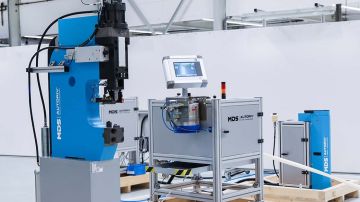
The A240 assembly system for robots and the A220 operator workstation can be used to insert rivet nuts (as well as self-clinching nuts) and ribbed washers into workpieces.
A robot or operator places a component on the washer, which is already on the die, and starts the pressing process. Then, the plunger delivers the nut and applies a force stroke, connecting the nut and washer to the component in a single-setting operation. The component is held by the robot or operator throughout the entire process. Nuts and washers are fed in via the corresponding feeding systems.
A special gripper mechanism transfers the washer. The feeding system delivers a washer when the corresponding sensor is available. Then, a slide moves the washer to the removal position, where it arrives in the correct alignment. When requested, the gripper picks up the washer and places it on the die. The gripper then returns to its starting position. Only then is a new washer moved to the removal position.

Advantages of the Nut Washer Combination
- This structural connection provides high torque, extraction, and pulling forces.
- Combining two clinching processes and one riveting operation reduces the number of process steps to one.
- This results in cost savings.
- The process is fully automatic and reliable.
- Fast cycle times and high availability are possible.
- The dimensions of the nut and washer are freely variable.
- Various special solutions are possible.
Application Example
Installation of a Self-Clinching Rivet Nut and Spacer in a Transfer Tool

In this project, the objective was to design a custom solution that would combine a self-clinching rivet nut and a spacer bushing, allowing both components to be installed automatically within a single production step. The challenge was that the installation had to be done in a single die station positioned at a 90-degree angle to the stamping direction and within a very confined workspace.
To achieve this, we designed the rivet nut and spacer bushing to integrate seamlessly into the transfer tool process. A comprehensive series of application tests was conducted to confirm process reliability.
The fasteners were developed simultaneously with the automation system design. This approach ensured that any potential feasibility issues were identified and resolved early in the project.
Thanks to our in-depth expertise in fastening technology and automated assembly, we were able to deliver a solution that met the technical requirements and ensured consistent, efficient production.

Nut Washer Combination vs. Blind Rivet Nut
The graphic shows both types of fasteners installed. The clinch nut can be used with or without a spacer, depending on the sheet metal thickness.

1. Blind Rivet Nut
Limited strength and low pull-through
- due to lower material hardness of a blind rivet nut
- due to less loadable small rivet bulge
- because there is no preload between the metal sheets
- as there is a risk of setting behavior within the connection
2. Self-Clinching Nut and Washer Combination
High strength and high pull-through

- due to highly tempered nut
- due to larger and higher nut dimensions
- because regular preload is built up between the metal sheets
- because of higher dimensions, no setting behavior within the connection
3. Self-Clinching Nut Without Washer
- Also used as standalone fastener with the same strength advantages
Request for Quotation
Would you like us to call you back? Leave your telephone number or e-mail, and we will get back to you as soon as possible!