Special Solutions for the Automation of Fasteners
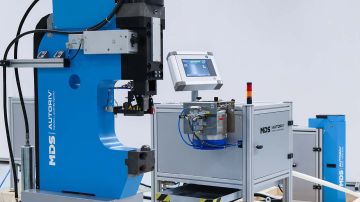
In addition to our standard products, we offer customized fastener processing solutions and specialty fasteners. We design and automate these solutions specifically for your needs.
With our extensive development capacity and many years of experience as a system supplier and toolmaker, we are prepared to assist you with your project. If standards are insufficient, we can meet all your requirements. Our proven modular system is the foundation for this.
We are happy to customize our standard fasteners for you. According to your specifications, we will optimize various application-related parameters, as well as the geometry, characteristics, and surface of the fastener.
Contact Us
Our customer service will help you with any questions!
Customized Developments Are Our Strength

Some projects require more than standard solutions. Therefore, specialty fasteners and processing technology solutions are necessary.
However, most system suppliers only sell standard products. Fastener manufacturers often only offer standard fasteners. It is difficult to find a vendor that can develop custom fasteners.
You won't find another system supplier that develops specialty fasteners and the necessary automation.
Thanks to our many years of experience and substantial development capacity, we excel at providing custom solutions, which is our unique selling point. These solutions stem from our modular system, which has been refined through decades of series production.
Your Benefits
- Many years of experience and know-how in both fasteners and automation
- Guaranteed, process-reliable feasibility
- Standard and special solutions based on proven modular systems
- Short development and delivery times with low costs and high availability
Adaptations for Difficult Assembly Situations

Often, it is necessary to place fasteners in angular positions to overcome difficult assembly situations.
We offer specialized solutions for installing fasteners at specific angles in tight spaces and hard-to-reach areas, such as:
- clinch nuts at an angle of 60 degrees
- combination of rivet nut and spacer at an angle of 90 degrees to the working direction

Further possible adaptations:
- adaptation to a specialty fastener
- adaptation to a special tool environment
- individual application direction and fastener delivery
- adaptation to the workpiece to be processed and the required component depths
Application Example
Transfer System for Rivet Nut Installation

The A280 transfer system is designed for complex assembly processes that require coordinated handling of components via transfer lines, integrated quality inspections, and automatic sorting of finished parts.
This multi-station assembly system automates and monitors the processing of parts via transfer lines. It enables the separate handling of OK and NOK parts. The system is ideal for complex assembly tasks requiring multiple sequential joining processes.
For this application, a fully automated installation process was developed using a custom-designed blind rivet nut. This solution improves upon the customer’s original concept by reducing downtime, minimizing system complexity, and decreasing the likelihood of quality issues. The modular automation platform also enables the reuse of individual system components in future production setups.
System Operation

Loading the Component
With the loading slide open, the operator places the component into the fixture. Guide elements provide coarse alignment, and precision pins at the reference points ensure accurate positioning of the component. Additional positioning elements support fine alignment. Sensors confirm correct placement.
Starting the Automatic Cycle
After positioning the component correctly, the operator closes the loading slide by retracting the slide cylinders. A sensor confirms that the slide is locked, which prompts the start of the automatic cycle.
Component Transfer Between Stations
The transfer unit lifts the component from the closed loading slide and places it in the fixture at the first assembly station. Then, the loading slide unlocks and opens, allowing the operator to load the next component. A lockable, pressure-regulating valve limits the slide force. During the cycle, the component is transferred sequentially from Station 1, to Station 2, to Station 3, and is finally placed in the unloading tray.
Positioning at the Setting Stations
At each station, the component is first aligned using guide elements, and then positioned precisely via locator pins. Sensors verify the component's correct position before pneumatic swing clamps secure it.

First Setting Operation
The X-Y gantry moves to the programmed fastening positions. According to the defined sequence, the corresponding setting unit installs the fasteners. Process parameters are recorded for each position to monitor quality. After installing all the fasteners at Station 1, the X-Y gantry returns to its home position.
Transfer to the Next Stations
The locator pins retract and the clamping devices open. Then, the transfer unit moves the component to Station 2, where the installation process is repeated. Finally, the component is moved to Station 3 for installation of the remaining fasteners.
Unloading Tray
After Station 3, the transfer system places the component into the unloading tray. There, sensors recheck the component and positioning blocks or guide elements realign it.
Lift-and-Rotate Station
A vacuum suction gripper picks up the finished component from the lift-and-rotate unit and moves it to the OK/NOK conveyor. Then, the component rotates 90°.

Handling of OK Parts (OK = within specification)
OK parts are placed on the OK conveyor. Light barriers ensure the conveyor is clear before each placement. Then, the unit returns to its home position. Once the component leaves the drop-off area, the next component can be placed. The OK part is transported to the end of the conveyor where an operator removes it. A light barrier monitors the end position.
Handling of NOK Parts (NOK = not within specification)
If the process parameters fall outside the permissible tolerances, or if a fastener cannot be installed, then the component is classified as "NOK." A message will appear on the operator panel that must be acknowledged by authorized personnel. Then, the component is transferred to the NOK conveyor. Light barriers check for available space. A signal light notifies the operator when the component reaches the removal position. The operator closes the removal window, which is secured by an interlock.
Request for Quotation
Would you like us to call you back? Leave your telephone number or e-mail, and we will get back to you as soon as possible!